Tuesday, March 8, 2011

F.A. Davis Author James Cawley to Receive Prestigious Award

I am absolutely thrilled to announce that one of our authors, the inimitable and brilliant James F. (Jim) Cawley, MPH, PA-C, will receive the 2011 Eugene A. Stead Jr. Award of Achievement from the American Academy of Physician Assistants (AAPA) at its annual conference in June.

Jim is being recognized for the "groundbreaking research he has done on PAs, which has advanced the PA profession and helped increase access to primary care through the use of PAs." Named after the late Gene Stead, founder of the PA profession, the Stead Award is given to an individual for "lifetime work that has a broad and significant impact on the PA profession as a whole."

Co-author of our book Physician Assistant: Policy and Practice, Jim has published extensively on primary care and health workforce policy. His early, and timely, papers about the budding profession helped policy makers recognize PAs as potential contributors to effective and efficient healthcare delivery. He has played a pivotal role in moving the PA profession forward through his work as a certified practitioner, educator, scholar, and leader. He is founder and director of The George Washington University's joint Physician Assistant-MPH program, the first of its type in the nation. The program trains individuals for careers that bridge clinical practice and prevention.

He is a Distinguished Fellow of the AAPA and a former president of the PA Foundation and the Physician Assistant Education Association. He served for five years on the National Commission on Certification of Physician Assistants, including on its Executive Committee. He is past member and vice chair of the federal Advisory Committee for Training in Primary Care Medicine and Dentistry, and a member of AAPA's Professional Education and Development Council and its Research Steering Committee.

Currently, Jim is Professor and Vice Chair in the Department of Prevention and Community Health at the George Washington University School of Public Health and Health Services. He is also a professor in the Department of Health Care Sciences in the GW School of Medicine and Health Sciences.

A PA for 35 years, Jim is a 1974 graduate of the Touro College PA program and holds an MPH degree in epidemiology from Johns Hopkins Bloomberg School of Public Health.

On behalf of all of us at F.A. Davis, I extend to Jim our heartiest congratulations on this signal honor so much deserved.

(And no, Jim, you can't add 200 pages to the next edition!)

Friday, March 4, 2011

E-Books and retrofitting content

E-book sales have skyrocketed recently, with Amazon reporting that Kindle sales now out-sell not only hard cover books but paperbacks as well and Barnes & Noble citing record profits from its e-books for the Nook.

For us educational publishers, that's great but what have e-books done for us lately?

The answer is, not much. E-books and e-readers have pretty much bombed on college campuses across the nation. For instance, the Kindle DX was supposed to revolutionize the way college students study. Not even close.

Daniel Turner, Associate Dean, Masters Programs, at the University of Washington, explained it best, telling Businessweek last year, "It's an amazing device for recreational reading, but it's not quite ready for prime time in higher education."

E-texts haven't taken off yet for one reason, and one reason only: We publishers have been attacking the issue all wrong, and until we change, the outlook will remain the same.

Retrofitting content

What we've all been doing, pretty much, is taking our existing content and retrofitting it for an electronic medium. We publish a book as print on paper (POP). We convert the book to PDF, XML, or some other electronic format. We put the book on the market and wonder why the sales don't explode.

The problem isn't with the conversion, you see, but with the content itself. We cannot take a product that was conceptualized and then built word by word by carefully chosen word—with a POP product in mind—and then retrofit it to an interactive medium. The writing itself must start out that way.

When we write a textbook, we generally start out with a set of objectives or outcomes, cover key terms, introduce the chapter, and then build the content in a sequence and format that makes sense for the content. It's a great method for a book. Perfect, really. But it falls short for an interactive product.

Forward-fitting the content

To develop a successful e-text we need to build it the way an e-student (the human reading an e-text) would use it. That means we would begin, basically, with a summary.

Yes, a summary. We would start with the core concepts the students need to learn and embed in those concepts links or other functionality that allows the reader to explore the content in the order they’re most interested in. We would need to allow for a sequential flow of content for linear learners while also building “content clouds” that would allow flexibility in learning sequence. And of course we need to add in all the functionality that has been developed to allow the e-student to highlight, take and share notes, download content updates, look up words, phrases, and references quickly, and other similar e-reader functions.

I firmly believe that only after we publishers start to develop products with e-students in mind will the e-text market live up to its potential.

Monday, February 28, 2011

What Is an Acquisitions Editor?

If you're at all interested in authoring a book of any kind, whether it's a textbook, collection of short stories, or the greatest novel ever written, you'll end up working with an acquisitions editor, sometimes called a sponsoring editor. Here's a quick rundown on what acquisitions editors (AEs) in healthcare publishing do.

Find 'n' sign

AEs essentially "find and sign" authors. They try to find the right author for the right book at the right time for the right market and in the right format (the 5 Rights in publishing).

Beyond the 5 Rights of publishing, AEs are also responsible for guiding the overall vision for a book and making sure that once the vision is clear and mutually agreed to by the author, the vision is followed throughout the entire publishing process.

AEs are responsible for knowing all about their assigned markets, including what they are, how they work, what kinds of products they need, and how they'll respond to the products we create. AEs build the company's publishing plan for each market. A publishing plan explains explain in detail what the market is and how the company should address it for optimal results.

Most AEs I know visit schools and attend conferences throughout the year in their disciplines, meeting people and learning about trends, curricula, books in use, and many other matters. They base decisions about which publishing projects to pursue and which to let go partly on that knowledge.

The AE is, in effect, the captain of a ship. Authors supply the cargo for that ship, and the captain guides the ship through the many possible hazards at "sea."

Essential duties

  • Develop with the author an overarching vision for the product

  • Oversee the author's creation of a proposal, table of contents, and sample chapters

  • Manage the proposal review process

  • Guide the author in revising the proposal to most effectively meet market needs

  • Champion the author's proposal to the decision-making body

  • Work through contractual issues between the company and author

  • Guide the development of the book from the time the proposal is approved until the book publishes

  • Support the marketing department to prepare relevant promotional materials

  • Support the sales department in their efforts to gain sales

  • Plan revisions of existing books
Oh, and just so you know…You needn't say, "Aye-aye," to the captain.

"Your Royal Highness" will do just fine.

Friday, February 18, 2011

Here's to You, Marti

Born today, February 18, and died May 2, 2009, our dear friend Marcia "Marti" A. Lewis, an F.A. Davis author for nearly 30 years, a wonderful author, a mentor, a teacher, a friend.

Rest in peace, Marti.

[caption id="attachment_818" align="alignnone" width="129" caption="Marti Lewis"][/caption]

Tuesday, February 15, 2011

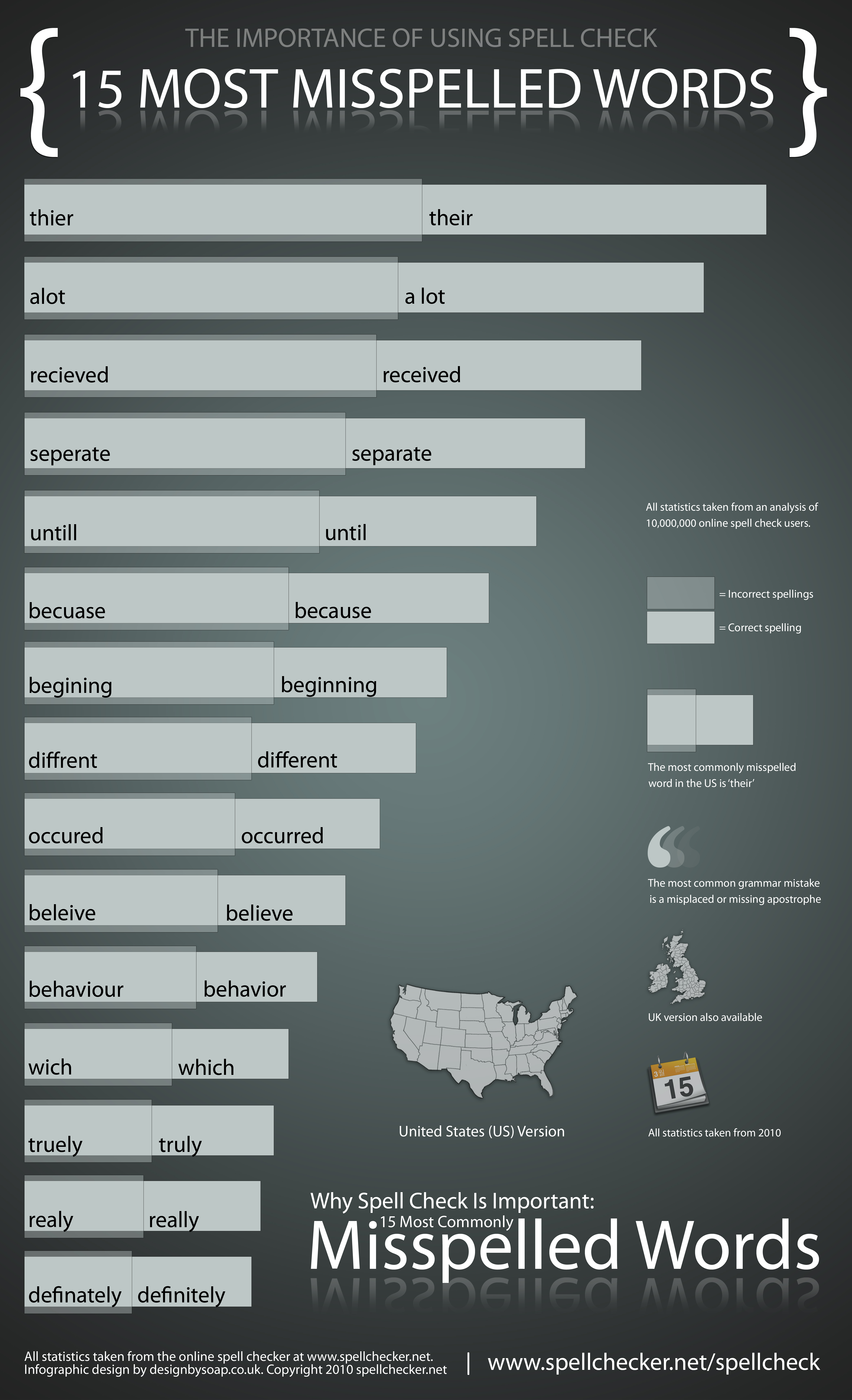
15 Most Misspelled Words

Last night my wife, a fifth-grade teacher at a local elementary school, was telling me about a little memory aid she had developed to help her students learn to spell a lot correctly. "They always spell it as one word," she said.

As I recall, that's when she grrrr-d.

Take heart, my love, your students are not alone in their misspelling of a lot.
Spellchecker.net recently published their list of the 15 Most Misspelled Words in the U.S., and guess which word came in second?

Right, alot.

(Perhaps the whole nation needs that little memory aid.)

Here, then, the full list from Spellchecker.net.

Misspellers, beware.

Tuesday, February 8, 2011

Tidbittles from an Editorial Mind

Odd bits and pieces of editorial wisdom. (Or stupidity, depending on how you look at it.)

  • Don't use colons after a heading. I mean, it's a heading, it's already separated from the body text. Why add a colon? It's redundant.

  • While we're at it, stop using underline in headings too. Also redundant. And annoying.

  • We ought to stop using "upon" when "on" works just as well and doesn't sound quite so pretentious.

  • A reminder: Quotation marks go OUTSIDE the punctuation in nearly all instances. Outside. Outside. Outside.

  • Stop using "and/or." That's just plain lazy. Writers should know the difference between the two. And if you think I'm the only person who fights against and/or, check this out: http://writingmatters.typepad.com/blog/2010/01/using-andor-in-a-sentence-is-just-plain-dumb.html

  • Hopefully, no one will use "hopefully" to mean "I hope." It means "full of hope." If you hope something will happen, say that. Don't say "Hopefully something will happen." Oh, ugh.