Showing posts with label Common Confusables. Show all posts

Tuesday, February 15, 2011

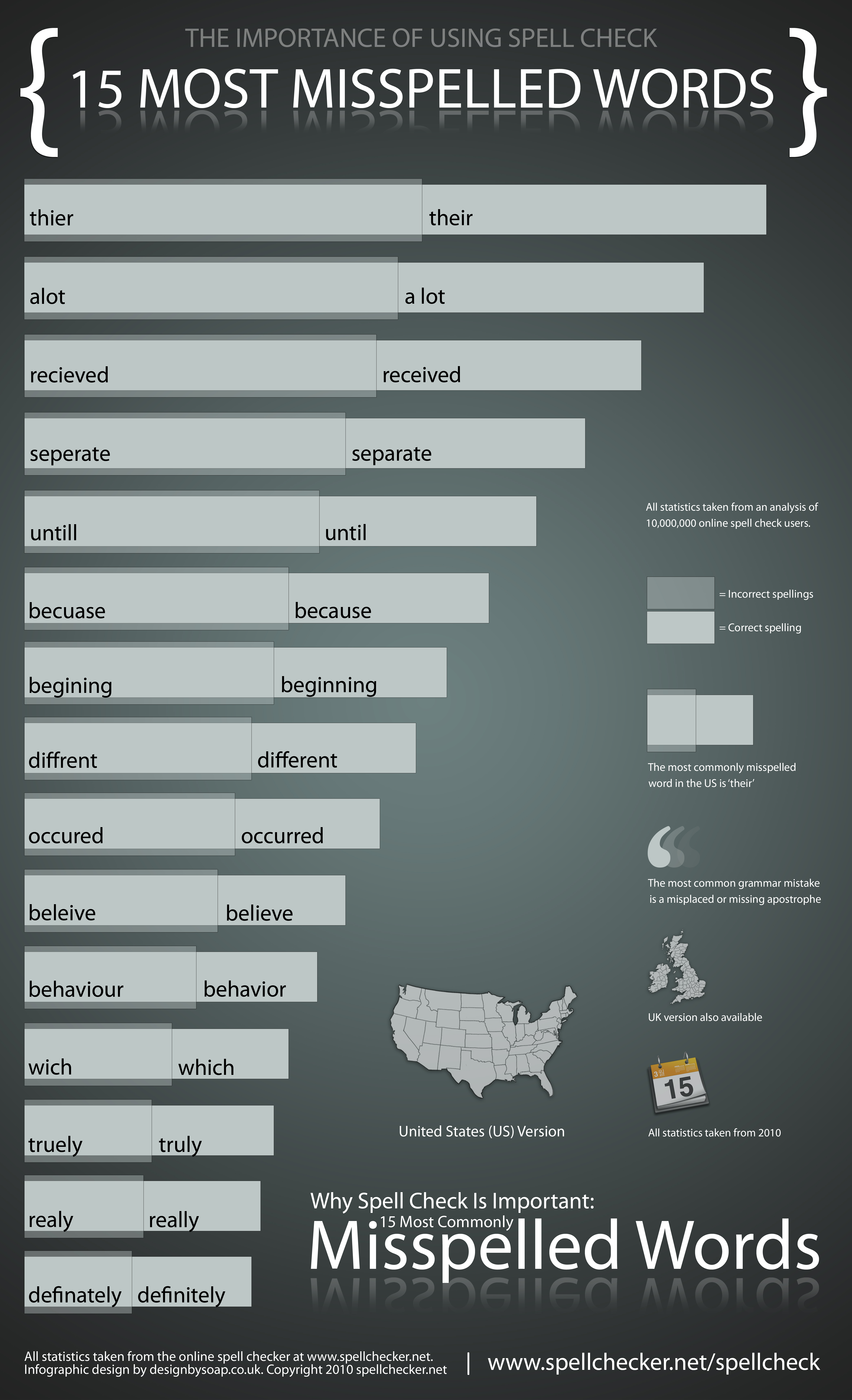
15 Most Misspelled Words

Last night my wife, a fifth-grade teacher at a local elementary school, was telling me about a little memory aid she had developed to help her students learn to spell a lot correctly. "They always spell it as one word," she said.

As I recall, that's when she grrrr-d.

Take heart, my love, your students are not alone in their misspelling of a lot.
Spellchecker.net recently published their list of the 15 Most Misspelled Words in the U.S., and guess which word came in second?

Right, alot.

(Perhaps the whole nation needs that little memory aid.)

Here, then, the full list from Spellchecker.net.

Misspellers, beware.

Wednesday, March 17, 2010

Commonly Misused Phrases

Let's have some fun today. Here's a list of commonly misused phrases and what the correct phrase should be.

If you've used the phrase on the left, uh-oh, better get it right next time!


Uh-OhYes, Please
It's a pigment of your imaginationIt's a figment (imagined story) of your imagination.
It's a mute point.It's a moot (of little practical value) point. (Of course, if you're Joey Tribbiani, the point is moo.)
That's a bold-faced lie.Nope, sorry, it's a bald-faced lie. (For the history of this phrase, see http://i.cx/1hn)
We need collaborating evidence.You more likely need corroborating (confirming) evidence.
It's a doggy-dog world out there.I don't know where you live, but where I live it's a dog-eat-dog world.
She's just a font of wisdom.If she's that smart, she's a fount (fountain or spring) of wisdom. Leave the fonts (typefaces) to us publishers.
Let's hone in on the problem.I'd much rather home (to navigate) in on it, thank you very much.
He must be lack toast and tolerant.Are you kidding me? If you've said this, just go home now.
Don't let your jealousy reel its ugly head.Hey, now, jealousies don't reel, they rear.
She scarred the heck out of me!If she burned you or cut you up with a razor, then surely she did scar (cause lasting tissue damage) the heck out of you. But I'll bet she just scared (afraid) the heck out of you.
He tripped over a wheel barrel.Aaaaaaaaaaargh! NO! He tripped over a wheelbarrow. People, people, do you never go to a Home Depot?


For more, visit http://eggcorns.lascribe.net/browse-eggcorns/.

Saturday, March 13, 2010

Common Confusables: Preventative & Preventive

In healthcare we’re always talking about preventing illness and accidents. The magazine Prevention focuses on steps people can take to prevent illness and accidents.

But when it comes to preventive and preventative or, heaven help us, preventatativeness, we get into trouble.

Does preventative mean the same as preventive? Or is there a difference?

Yes, and yes.

Okay, here’s the deal.

You’ll hear from some folks that preventive is an adjective, as in “preventive medicine,” and that preventative is a noun, as in, “The herb is a preventative.” Those folks may cite the use of preventative as a noun and preventive as an adjective since the 17th century, and they would be correct.

Another group of folks insist that the terms possess identical meanings and can be used interchangeably. They as well would be correct.

Language is constantly evolving, and this is one of those evolutionary instances. When the experts can’t agree, as in this particular case, then the meanings are so close as to be essentially non-existent and the usage so mixed that no clear “winner” emerges.

So use whichever one you like. If someone calls you on it, believe me, you’ll find more than enough experts backing up your choice.

For me, I like preventive. I like how it sounds. To me it seems a bit more medical than preventative.

But that’s just me.

Thursday, February 25, 2010

Common Confusables: Lose & Loose

I can't tell you how many times people blow this one. So let's see if we can't get it right.

When you provide a Las Vegas casino with additional revenue, you say, "Gee, I hate to lose money at the slots."

When the knot you've tied comes untied, you say, "Gee, I guess I tied that knot kind of loose."

So, any LOSS gets a single o — LOSE.

Anything that isn't tight gets a double o —L O O S E.


(And while we're sort of on the topic, I'd like to tell the otherwise wonderful comedian, Jim Gaffigan, that he needs a wheelbarrow to carry a Cinnabon, not a wheel barrel. Sheesh, Jim, get with the program!)

Wednesday, February 24, 2010

Common Confusables: Convince & Persuade

I can hear some of you out there asking, Hey, you, is there a difference between convince and persuade?

The answer is extremely simple, simpler than most language pundits would have you believe.

The answer simply, clearly, and unabashadly is no, and don't let anyone tell you otherwise.

Oh, sure, they'll try to tell you that one requires more logic or reason, or that one can be followed by "to" and the other can't.

Bullpucky. They're synonyms without a substantive difference between them, so feel freely to use either whenever you see fit.

There. Did I persuade you?

(See what I did there? I chose persuade instead of convince. Wow, the raw power of choice!)

Tuesday, February 2, 2010

Common Confusables: Sounds and the Use of A and An

You've heard them, you know you have, those, those people, for wont of a better word, who use the wrong article before a noun.

"Hey, I've got a idea. Let's have a egg for breakfast."

I could just scream.

This "rule" is so simple, it's mind-numbing how many people get it wrong.

Does the first syllable of the next word sound like a vowel? Then it gets an. If the first syllable sounds like a consonant, it gets a.

Hear that? It's the first sound.

So for "idea," "egg," "ointment," and every other danged vowel word, use an. Please. I'm begging you. Begging with every fiber of my being. An.

For almost everything else, use a.

I think what messes up most people are words that start with h, like honor, huge, and historical.

Here the rule, if you can call it a rule, is that if the h is silent, like it is in honor, use an. Otherwise go with the sound—hhh. Hhhonor. Hhhistorical. Hhhuge. (Not "yyyuge," by the way. Where do people get off saying "yyyuge"?)

So, to clarify, it's "It's an honor, your Honor."

It's "To put it into a historical context…"

It's "Hey, I've got an idea."

It's "Let's go to a movie tonight."

So, do we have AN agreement?

Friday, January 22, 2010

Common Confusables: Nauseous & Nauseated

To many people, there is a distinct difference between nauseous and nauseated. The first, nauseous, means causing nausea in someone else, as in, "Your perfume makes me nauseous."

The latter, nauseated, means to feel or suffer from nausea, as in, "I'm feeling nauseated from your perfume."

The trouble is, language is a constantly evolving thing, for better or worse, and this is one of those evolutions.

Nowadays, in the US and UK, the terms are often used interchangably. Purists might argue about that, absolutely, but historically they aren't supported.

Author and consultant for the Oxford English Dictionary, Michael Quinion, blogging at World Wide Words (http://www.worldwidewords.org/qa/qa-nau1.htm), explains.

When nauseous means "feeling physically sick", it usually appears after a verb such as feel, become, get or grow: "Doctor, I'm feeling nauseous." When it means "causing nausea", it is much more likely to be used before a noun: "To conceal the nauseous flavour of the raw spirit they added aromatic herbs and spices." Much of the older sense of nauseous, both literal and figurative, is in the process of being transferred to nauseating: "To this, with nauseating smarminess, he immediately attested", "The children looked a little green from the nauseating fairground rides." Nauseated, to judge from the citation evidence, now seems to be less common than either.


Basically, when you're not sure which to use, stick with nauseous.

Unless you're talking to a purist, as I was just the other day, when I used nauseous instead of nauseated and he called me on it.

But Professor, it was just casual conversation!
Friday, January 8, 2010

Common Confusables: Gone & Went

This common confusable is more often spoken incorrectly than written but it drives me nuts nonetheless.

"I should have went to the bar last night."

Oh, come on. Seriously?

You know, of all the verbs you could get wrong, "go" shouldn't be one of them. It's one of the simplest we have.

Most people do pretty well with the present tense:

"I want to go to the store."

"He keeps going on and on about Twitter."

"He goes, like, 'Duh.' And I go, 'Uh…yuh!'"

So yes, we do pretty well with go. But that's it. That whole gone versus went part seems to elude us. Want to remember which to use? Here's how:

No other word goes with went.

"He went to the park."

"She went to the grocery story."

"They went, and then I went, to the bar and got toasted."

It's not should have went or could have went. No.

No, no, no, no, NO!

When you feel the urge to add other words (as in the past perfect tense), use gone.

"I should have gone to the park."

"I might have gone to the grocery store if I knew she was going to be there."

"I could have gone to that job interview but I slept in."

And by the way, it's should HAVE and could HAVE, not should OF and could OF.

Grrrrr.