Showing posts with label Grammar. Show all posts

Wednesday, January 23, 2013

3 Quick Grammar Tips for Textbook Authors

Sometimes you just have to vent. This is one of those times.

Health care textbook authors, listen up, I've got a few grammar and usage tips for you.

#1  Enough with the reminders, already

Stop writing, "as mentioned previously," "as we'll discuss in chapter X," and other such reminders. If you mention something previously there's no need to call attention to it again. Just go on with what you're talking about, it will be okay.

And if you're going to talk about something later, don't tell the reader about it now. What good does that do? Just say what you're going to say, and let the reader find the new material later. It will be more fun that way!

#2  i.e. and e.g.

Hate these little, archaic abbreviations. Hate them like poison. Why?

Because they represent lazy writing. What, you can't write out that is? You have to write i.e.? Is for example or for instance (e.g.) so difficult?

Don't make the reader think back and ask, Wait, what does "i.e." mean again?

YOU know what it means, so just write it!

#3  Punctuation outside quotation marks

If you're writing for a U.S. audience, put the hang-danged quotation marks OUTSIDE the punctuation!

Yes, yes, I know, the marks go inside a colon or semi-colon most of the time, but that's the exception. It's  much better to get the exception wrong sometimes and the "rule" right most of the time, don't you think?

Thanks for listening.

Thursday, December 8, 2011

Double Space After a Period? NOOOOOO!

He writes, "Can I let you in on a secret? Typing two spaces after a period is totally, completely, utterly, and inarguably wrong."


Came across a blog this morning by Farhad Manjoo at Slate about the use of two spaces after a period: http://goo.gl/S6FqU


He goes on to explain the history of this practice and urges everyone to get a clue and stop using two spaces!

Farhad explains how many typographers react to double spaces:
Type professionals can get amusingly—if justifiably—overworked about spaces. "Forget about tolerating differences of opinion: typographically speaking, typing two spaces before the start of a new sentence is absolutely, unequivocally wrong," Ilene Strizver, who runs a typographic consulting firm The Type Studio, once wrote. "When I see two spaces I shake my head and I go, Aye yay yay," she told me. "I talk about 'type crimes' often, and in terms of what you can do wrong, this one deserves life imprisonment. It's a pure sign of amateur typography." "A space signals a pause," says David Jury, the author of About Face: Reviving The Rules of Typography. "If you get a really big pause—a big hole—in the middle of a line, the reader pauses. And you don't want people to pause all the time. You want the text to flow."

So please, tell your students, your friends, your neighbors, your manicurist, for cryin' out loud: STOP USING TWO SPACES!

I thank you, and I'm sure Farhad would thank you too.

Monday, July 11, 2011

2 Key Things Writers Need to Know About the Oxford Comma

The vaunted Oxford comma has been in the news lately. To wit:

Never heard of the Oxford comma, you say? What's all this fuss about the Oxford comma?

The Oxford comma is the comma that follows the last item in a series, just before the "and," "or," or some other conjunction. You might know it by its more popular name, the serial comma. (See below.)


Writers and English teachers know all about the Oxford comma. The rest of us, not so much.

Keys 1, and 2

To my mind, writers and authors need to know just two things about the Oxford comma, and two things only.

  1. The Oxford comma is helpful in managing lists. Most of the time we craft reasonably simple lists in which each item is independent and not tied conceptually to another item. Here are some examples:
  • The patient c/o nausea, vomiting, and diarrhea.

  • He grimaced, flexed his right leg, and pointed to his right lower quadrant

  • The drug is contraindicated in anaphylaxis, severe combined immunodeficiency, coma, reduced level of consciousness, or pregnancy.
But suppose one of the items needs to be clearly tied to another item? That's when the Oxford comma really shines. Notice the difference in meaning between these two lists:
  • The patient was visited by his wife, a co-worker and a friend.

  • The patient was visited by his wife, a co-worker, and a friend.
In the first, the wife was apparently the only visitor. In the second three people showed up.
  1. Conform to the publisher's style. Maybe you're a firm believer in the Oxford comma. Or maybe you would just as soon see it disappear forever. Whatever you think actually makes no difference when you're writing for publication. You need to know whether the publisher uses it, and if so, then you use it too.

    To find out what a particular publisher prefers, check a few of their books, journals, or magazines. Do you consistently see the Oxford comma? Then use it.

    If you don't see the comma used consistently, then assume you can either use it or ditch it, as you see fit.

My recommendation

Use it always. Makes life so much easier.

Now go forth and write, create, formulate, scribe, scribble, and publish!

Tuesday, February 15, 2011

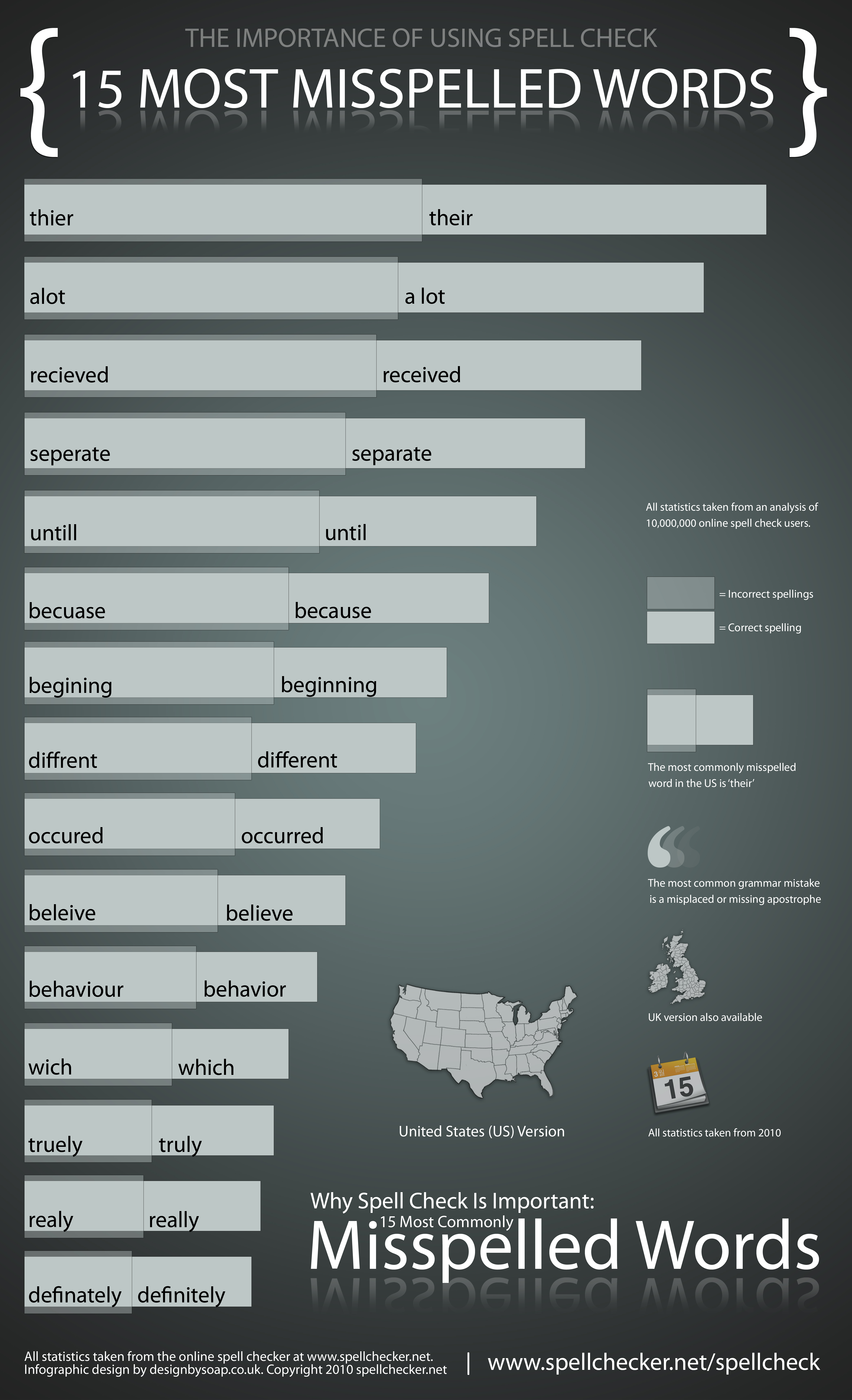
15 Most Misspelled Words

Last night my wife, a fifth-grade teacher at a local elementary school, was telling me about a little memory aid she had developed to help her students learn to spell a lot correctly. "They always spell it as one word," she said.

As I recall, that's when she grrrr-d.

Take heart, my love, your students are not alone in their misspelling of a lot.
Spellchecker.net recently published their list of the 15 Most Misspelled Words in the U.S., and guess which word came in second?

Right, alot.

(Perhaps the whole nation needs that little memory aid.)

Here, then, the full list from Spellchecker.net.

Misspellers, beware.

Tuesday, February 8, 2011

Tidbittles from an Editorial Mind

Odd bits and pieces of editorial wisdom. (Or stupidity, depending on how you look at it.)

  • Don't use colons after a heading. I mean, it's a heading, it's already separated from the body text. Why add a colon? It's redundant.

  • While we're at it, stop using underline in headings too. Also redundant. And annoying.

  • We ought to stop using "upon" when "on" works just as well and doesn't sound quite so pretentious.

  • A reminder: Quotation marks go OUTSIDE the punctuation in nearly all instances. Outside. Outside. Outside.

  • Stop using "and/or." That's just plain lazy. Writers should know the difference between the two. And if you think I'm the only person who fights against and/or, check this out: http://writingmatters.typepad.com/blog/2010/01/using-andor-in-a-sentence-is-just-plain-dumb.html

  • Hopefully, no one will use "hopefully" to mean "I hope." It means "full of hope." If you hope something will happen, say that. Don't say "Hopefully something will happen." Oh, ugh.

Friday, January 14, 2011

Pre-Ordering and Other Stupid Expressions Writers Should Ban

Pre-explaining my utter
aversion to the use of pre-pretty much anything, I should explain that I have nothing against those three letters and their accompanying itty, bitty dash. Not at all.

However, I object to their use to signify anything we've done before we actually do what we've already done.

Take "pre-packaged," for instance. If a manufacturer packages a food in, say, a bag, it is at that point packaged. How on earth did that same packaged food become pre-packaged when it hits the store, hmmm? What magic occurred en route to make it so?

Please, people of Earth, please stop using this horrifically stupid expression and others like it! To wit:

  • Pre-meeting

  • Pre-conference

  • Pre-reading

  • Pre-writing (We're writers, we can't come up with anything better than "pre-writing" to describe writing warm-up activities?)

  • Pre-order

  • Pre-book

  • Pre-purchase

  • Pre-recorded

  • Pre-drink

  • Pre-enough!


Other stupid expressions


  • Each and every (Can you have an each but not an every? I think not.)

  • Reread (Is rereread next?)

  • Personal friend (Dontcha just hate those impersonal ones? Those bums!)

  • General public (Now, Colonel Public I can understand.)


  • Regular routine (What, there's an irregular routine? Well, helloooo, FiberCon!)


  • Advance registration (Oh, now this one is just silly. It should be pre-registration!)


Do your part. Banish the stupid!

Friday, March 19, 2010

Confusing Commas

On the list of most common grammatical errors, misused commas rank right up there with misspellings and Mrs. Batchelder's rank perfume and hissing s.

(Sorry about that, I got a bit carried away. Every time I think about an English class I flash back to crazy old Mrs. Batchelder's high school English classroom. Then I throw up.)

So let's tackle commas in a way I hope will make sense.
First up: Serial commas

I prefer serial commas because they help reduce confusion. Serial commas are commas used after the next to last item in a list. Here's an example:

The patient complained of nausea, vomiting, and headache.


The comma after "vomiting" is a serial comma. You don't have to use one, but I do think they can be helpful in certain situations. So when in doubt, use it.
Next: Introductory phrases

Commas after an introductory phrase are rapidly losing their grip on us, and thank goodness. These are examples of introductory phrases:

  • After awhile

  • On the other hand

  • After the patient had gone to the bathroom


These phrases set up the rest of the sentence. Your English teacher probably smacked you upside the head if you didn't use a comma after an introductory phrase, but he had better not do that now unless you're writing for beginning readers. If you're writing for adults with a reading level over, say, the 10th grade, you needn't worry about sticking a comma after a beginning-of-the-sentence phrase. Use them only if leaving them out makes the sentence confusing, as in:

You know it seems odd that the window was left open like that.


The writer probably meant the sentence this way:

You know, it seems odd that the window was left open like that.


That kind of situation demands a comma.
Separating "sentences"

This is probably the toughest one for people to remember: When do you use a comma when you have what we call a complex sentence?

Generally if you have two complete sentences on either side of an and, but, or, nor, or any other what you wanna call yer conjunctions, use a comma. For instance, if we put these two sentences together…

Mr. Robinson knocked over the lamp.


AND


I ran into the room to find out what happened…


We would use a comma, as in:

Mr. Robinson knocked over the lamp, and I ran into the room to find out what happened.


Here, though, you would NOT use a comma:

Mr. Robinson knocked over the lamp and yelled for help.


Why no comma? Because "yelled for help" isn't a complete sentence.

Okay, class, that's enough for today.

Saturday, March 13, 2010

Common Confusables: Preventative & Preventive

In healthcare we’re always talking about preventing illness and accidents. The magazine Prevention focuses on steps people can take to prevent illness and accidents.

But when it comes to preventive and preventative or, heaven help us, preventatativeness, we get into trouble.

Does preventative mean the same as preventive? Or is there a difference?

Yes, and yes.

Okay, here’s the deal.

You’ll hear from some folks that preventive is an adjective, as in “preventive medicine,” and that preventative is a noun, as in, “The herb is a preventative.” Those folks may cite the use of preventative as a noun and preventive as an adjective since the 17th century, and they would be correct.

Another group of folks insist that the terms possess identical meanings and can be used interchangeably. They as well would be correct.

Language is constantly evolving, and this is one of those evolutionary instances. When the experts can’t agree, as in this particular case, then the meanings are so close as to be essentially non-existent and the usage so mixed that no clear “winner” emerges.

So use whichever one you like. If someone calls you on it, believe me, you’ll find more than enough experts backing up your choice.

For me, I like preventive. I like how it sounds. To me it seems a bit more medical than preventative.

But that’s just me.

Thursday, March 11, 2010

Using Similes and Metaphors to Help Patients Learn

Similes and metaphors can act as cool, brisk breezes on a sweltering summer day. They can soothe a patient's frayed emotions, clarify a confusing concept, or build support for difficult lifestyle changes.

The trick is to use them wisely, not toss them about willy-nilly.

First, though, definitions.
Definitions

A simile is a comparison of two unlike things, typically marked by use of "like" or "as." Here are a few examples:

  • The skin on his shin was as smooth as polished marble.

  • He has a face like an open book.

  • The dressing absorbed the fluid like a sponge picks up water.


A metaphor is an indirect comparison between two or more seemingly unrelated subjects, often taking a " blank is a (or an) blank " form. Examples:

  • Think of the urinary tract as a set of waterworks.

  • Your illness is a real puzzle.

  • The skull caved in.


Similes and metaphors can convey a great deal of information in just a few words. They can also help make complex information more meaningful to the patient, thus enhancing learning and, one hopes, improving health outcomes.

Although these literary constructs generally shouldn't be used in clinical documentation, they can be invaluable in talking with patients, explaining procedures, discussing at-home care, and in similar situations.
Examples

Imagine a healthcare professional, while discussing how new capillaries form in the heart when a vessel becomes partly blocked, says to the patient, "The capillaries grow around the blockage like ivy around a fence post."

You can just feel the patient learning and see the light bulb flashing over his head.

A few more examples:

  • It's the kind of itching that feels like ants running around your leg.

  • Please squeeze this ball gently, like it's a squeeze bottle of ketchup.

  • It sounds like the "ping" in a ping-pong match.


Just be careful and make sure the imagery is positive, not negative. Consider these examples as the kind you should avoid:

  • Cancer therapy as a "war"—This is a rather masculine, power-based, and even violent metaphor and may be misconstrued by the patient as if the war can be won if only she fights hard enough.

  • Comparing an arthritic knee to an old car—Don't try this one, especially if the person is, um, significantly life-experienced. (Read: Older.)

  • Disease as a "pit bull" or some such—Yikes! We may think that way as healthcare providers, but that doesn't mean the patient should.


Planning ahead

Most people can't think of really good similes and metaphors in healthcare right off the top of their head. So do this.

If you find yourself describing certain procedures or treatments frequently, sit down and think of three solid, clear metaphors or similes that won't scare a patient. Memorize them, and then use them the next time you're performing the procedure.

Then you'll be as ready as Custer was at Bull Run. Wait, what? That's not right, is it? Hmm, I'd better keep thinking of a good simile.

____________________

I'm indebted to two key sources for this post, and I thank them profusely.

Wednesday, February 24, 2010

Common Confusables: Convince & Persuade

I can hear some of you out there asking, Hey, you, is there a difference between convince and persuade?

The answer is extremely simple, simpler than most language pundits would have you believe.

The answer simply, clearly, and unabashadly is no, and don't let anyone tell you otherwise.

Oh, sure, they'll try to tell you that one requires more logic or reason, or that one can be followed by "to" and the other can't.

Bullpucky. They're synonyms without a substantive difference between them, so feel freely to use either whenever you see fit.

There. Did I persuade you?

(See what I did there? I chose persuade instead of convince. Wow, the raw power of choice!)

Tuesday, February 2, 2010

Common Confusables: Sounds and the Use of A and An

You've heard them, you know you have, those, those people, for wont of a better word, who use the wrong article before a noun.

"Hey, I've got a idea. Let's have a egg for breakfast."

I could just scream.

This "rule" is so simple, it's mind-numbing how many people get it wrong.

Does the first syllable of the next word sound like a vowel? Then it gets an. If the first syllable sounds like a consonant, it gets a.

Hear that? It's the first sound.

So for "idea," "egg," "ointment," and every other danged vowel word, use an. Please. I'm begging you. Begging with every fiber of my being. An.

For almost everything else, use a.

I think what messes up most people are words that start with h, like honor, huge, and historical.

Here the rule, if you can call it a rule, is that if the h is silent, like it is in honor, use an. Otherwise go with the sound—hhh. Hhhonor. Hhhistorical. Hhhuge. (Not "yyyuge," by the way. Where do people get off saying "yyyuge"?)

So, to clarify, it's "It's an honor, your Honor."

It's "To put it into a historical context…"

It's "Hey, I've got an idea."

It's "Let's go to a movie tonight."

So, do we have AN agreement?

Friday, January 22, 2010

Common Confusables: Nauseous & Nauseated

To many people, there is a distinct difference between nauseous and nauseated. The first, nauseous, means causing nausea in someone else, as in, "Your perfume makes me nauseous."

The latter, nauseated, means to feel or suffer from nausea, as in, "I'm feeling nauseated from your perfume."

The trouble is, language is a constantly evolving thing, for better or worse, and this is one of those evolutions.

Nowadays, in the US and UK, the terms are often used interchangably. Purists might argue about that, absolutely, but historically they aren't supported.

Author and consultant for the Oxford English Dictionary, Michael Quinion, blogging at World Wide Words (http://www.worldwidewords.org/qa/qa-nau1.htm), explains.

When nauseous means "feeling physically sick", it usually appears after a verb such as feel, become, get or grow: "Doctor, I'm feeling nauseous." When it means "causing nausea", it is much more likely to be used before a noun: "To conceal the nauseous flavour of the raw spirit they added aromatic herbs and spices." Much of the older sense of nauseous, both literal and figurative, is in the process of being transferred to nauseating: "To this, with nauseating smarminess, he immediately attested", "The children looked a little green from the nauseating fairground rides." Nauseated, to judge from the citation evidence, now seems to be less common than either.


Basically, when you're not sure which to use, stick with nauseous.

Unless you're talking to a purist, as I was just the other day, when I used nauseous instead of nauseated and he called me on it.

But Professor, it was just casual conversation!

Friday, January 15, 2010

Common Confusables: They’re, There, & Their

They're, they're now, their all here. They're's no need to worry anymore.

Here's a set of words that we get right all the time in speech.

Every time we say any of them, we're using the right one because no one can see how those words are spelled. When we write, though, getting one of them wrong makes us look like we're a few letters short of an alphabet. So let's work to get them right, shall we?

They're

This one is the easiest, I think, because it's a contraction. Contractions are shortened forms of two words. A few examples:

  • Don't = do not
  • Aren't = are not
  • It's = it is

Simple, right? Well, there're is just a contraction of there are. So if there are would be correct in what you're writing, then go ahead and use they're.

There

This form is directional, basically. It points to something. It's not over here, it's over there.

Their

This form is possessive, meaning somebody owns somethin', and it probably ain't me. So if it ain't mine, and it ain't yours, it must be theirs. Am I right, people? Of course I am!

Oh, and by the way. The word "ain't" is perfectly acceptable grammatically. Sure, some people frown on its use, but it's a colloquial term, meaning its use in formal settings should be avoided.

But this blog is rather informal, don't you think, and so using a colloquialism would be acceptable. Besides which, it's my blog and I happen to like the word.

So there.

Friday, January 1, 2010

Common Confusables: Effect & Affect

Lots of intelligent folks sometimes get affect confused with effect in their writing, so don't fret none if you struggle with differentiating the two. I should say three, actually, because those of us in health care deal with patients and their emotional presentation, or affect. So let's see if we can straighten out the confusion.

Effect

Let's take this one on first. By and large, an effect (pronounced eh-FEKT) is a noun. It is something that results from something. "The drug had the desired effect." "The intervention caused no effect on his behavior."

This form is also used to describe one's belongings. "We stored the patient's personal effects in a bag."

Scientists use effect to describe a law of some kind such as the photovoltaic effect. There are other meanings as well but nearly all of them are used as nouns.

Sometimes effect is used a verb, but not often, at least not in health care. "The Director of Nursing is trying to effect a change in the way adverse reactions are reported." Clinically, though, effect isn't used much as a verb.

Affect

By and large, the word affect (pronounced uh-FEKT) is used as a verb. It is something that happens. "Rheumatic fever can affect the heart and cause lasting damage to the myocardium." "Those two Code Blues have affected the staff's ability to deal with other patients."

But another meaning of the word, one used as a noun, is highly pertinent to healthcare professionals: affect (pronounced AH-fekt). This noun refers a patient's mien, countenance, or emotional presentation. "The mother exhibited a flat affect as she explained how her son was burned." "Expect to see a flat or blunted affect when dealing with a patient with schizophrenia."

So, aside from describing a person's demeanor, figure using effect when you need a noun and affect when you need a verb. Hope that helps.

Monday, December 21, 2009

Common Confusables: Since & Because

This one may turn out to be a losing cause, but I'd like to fight to keep it "old school."

These two words are commonly misused, even by intelligent, articulate writers and speakers. Here's how to use them correctly:

Because is used when providing a reason for something. "I went to the store because we needed milk."


Since is used when dealing with time. "We've needed milk since this morning."


Unfortunately a great many people use since as a replacement for because. I'm not sure why, but that's the way it is, which leads me to think that eventually, if it hasn't happened yet, the two words will be considered officially synonymous. Bummer, man.

Common Confusables: Introduction

This post introduces a periodic look at words and phrases commonly confused, abused, and misused in our endlessly variable vernacular. I hope to present a Common Confusables post every week, and for your enjoyment I present the first one, Regime & Regimen.

Regime & Regimen


You've heard of several "fitness regimes," haven't you? Of course you have, they're all over the place. Same with "diet regimes." And even US Representatives have been heard asking—in this case NC Rep. Virginia Foxx asking of Roger Clemens about steroid use—"Mr. Clemens, maybe you'd like to talk about your regime and how hard you work?"

Okay, um, no!

Clemens doesn't have a regime, okay? Really, he doesn't. He may think he does, but he doesn't. What he has is a regimen. Huge difference. Huge.

A regimen is a regular course of action or treatment or a period of training or schooling, as in "My morning regimen includes a brisk walk." Or, "This program has an aggressive learning regimen."

A regime is a political system, as in "Saddam Hussein's regime was finally taken out of power." Or, "Our principal is a jerk. I think we should work toward a regime change. Wanna?"

So let's have no more of these fitness regimes, okay, Andy Green? Jennifer Scott? Women Fitness.com?

No more diet regimes, okay, Dr. Kiki Sidhwa? OK! Magazine? And Encyclopedia.Com?

Stop the madness!!!!!!!!!!!!!!!!

Friday, December 18, 2009

Fear and Language Changes

Lots of factors drive changes in a language. New technologies is a key factor nowadays. Laziness, in a way, accounts for some changes too, contractions being a prime example. But sometimes fear does it too.

I've been noticing the last few years an overwhelming number of otherwise intelligent people who use "more" instead of adding "-er" to a word. For instance, I've heard "more clean" instead of cleaner, "more firm" instead of firmer, and even "more funny" instead of funnier. I've also seen these kinds of phrases in printed media, from ads to blogs to newspapers and magazines. And don't even get me started on the number of news anchors and other TV personalities who do the same thing when speaking off the cuff.

It seems that people have become so reluctant to take a crack at the correct -er word that they automatically shift to the more construct. Do these people not read? Did they attend lousy schools? Did they have teachers who didn't know the difference themselves? Or did they, as I think might be the case, struggle with learning the -er words and, on top of that, have teachers and parents who corrected them so often that they just gave up, deciding to use the more construct, regardless of what they think the correct one is?

I don't know, but I'm wondering whether this observation is an indication of a shift in our language toward the more construct in all cases. Hmmmm.

Wednesday, December 16, 2009

Could You Care Less, Really?

A good friend of mine is wont to exclaim, "I could care less what she thinks."

And that's fine, but by saying that he "could care less," he actually is saying sure, he could care less if he wanted to, but he doesn't want to. Right now he just wants to care a little.


I think what he really means, though, is that it's just not possible for him to care less than he does now. So he should say, "I couldn't care less what she thinks."

That's far more accurate, don't you think?

Tuesday, December 15, 2009

Less vs. Fewer

This one really sticks in my craw. I blame an old Miller Lite commercial. "It has less calories than their reg-ler beer," I remember John Madden saying in that infamous ad. That's just plain wrong. It might have FEWER calories than their regular beer (don't get me started on his mashing of "regular"), but it doesn't have LESS.

Here's the deal. If you can count something—1, 2, 3, 4…—use fewer. If you can't, use less.

Examples:

  1. It has fewer calories than their regular beer. (Fewer, because you can count the calories.)

  2. There is less beer in this glass than this one. (Less, because you can't count "beer.")

  3. The patient received fewer analgesics today than yesterday. (Fewer, because you can count the number of analgesics.)

  4. The patient has less pain today than yesterday. (Less, because you can't count "pain.")


As with everything, it seems, there are exceptions, but they're easy ones. Generally speaking, use less when talking about time or money.

Examples:


  1. I've got less than 4 hours left to work! (Less, because we're talking about a time period, not about four individual hours.)

  2. You've got less money than me. Don't even THINK about borrowing anything. (Less, because we're talking about the total amount of money, not the specific number of bills and coins.)


Hope that helps.