Showing posts with label Writing. Show all posts

Tuesday, September 13, 2016

Looking Forward to Doing Nothing


There’s never enough time to do all the nothing you want.
— Bill Watterson, Calvin and Hobbes


I've been hugely fortunate in my life to do the things I've wanted to do and get paid for them.

I loved my time as an operating room technician (now called a surgical technician). I loved most of the years I practiced nursing, especially those spent in the ICU/CCU (now called the SICU and MICU) and in alcohol and drug rehab. I loved my years teaching nursing, especially my course on geriatric nursing. And I've fully enjoyed my time publishing reference and textbooks for a variety of healthcare students, from medical assisting to nursing to physician assistant students.

It's time now to switch gears and do something else I want to do. I just won't get paid for it. Bummer.

I will be retiring on September 30, 2016, and will be inactivating this blog a time thereafter.

Note: If you would like to follow my personal blog, in which I write about whatever I feel like writing about, you're certainly welcome. Visit http://dontfretnone.blogspot.com/


Thank You

I've met so many wonderful people over the years that I couldn't possibly thank them all for their many kindnesses. But here are some friends and colleagues, some living, some now gone, I'm extraordinarily grateful for having known:

  • Nancy Macaulay, friend, mentor, and nurse extraordinaire
  • Pat Schull, the best business mind I've ever known and an incredible person to boot
  • Nancy Webb, by far the best editor I've ever worked with
  • Vince Marteka, who helped refine and strengthen my writing in his warm and welcoming way
  • Rob Craven, Jr., for his generosity and for helping me find golf again
  • Nancy Dunbar, a ridiculously good nurse gone far too soon
  • Glenn Bricker, MD, who helped point me to a career in healthcare a waaay long time ago

I would like to express my gratitude as well for the honor of knowing and working with many magnificent authors, people who moved me through their friendship, professionalism, and dedication, Here are some of them, in no particular order:

  • Sharon Eagle, bravery beyond compare
  • The amazing and wonderful Carol Tamparo, and also her delightful husband Tom
  • Cindi, Cheri, and Candy, my marvelous drinkin' buddies
  • Sue Perreira, that great ball of fire
  • Mort Diamond, O! Great Man O' Words
  • Jim Cawley, Rod Hooker, and Mona Sedrak, the perfect trio of dinner guests
  • Connie Lieseke, Terri Brame, Jackie Thelian, and Nancy Gardner, who didn't benefit from their terrific books anywhere near as much as they should have
  • The remarkable Debbie Sullivan
  • Bill Tindall, Ed Weber, and Dennis Blessing
  • Arlene Muller, Scott Massey, Jack Coulehan, and Marian Block
  • The incredible Barbara Gylys and her hugely talented daughter Regina
  • Gary White, a multitalented rock star

What's Next?


So, what's next for me? Well, at this point I have three adorable grandchildren to fuss over. I have many books I want to read and many golf courses to bungle my way through. Mostly I want to write what I want to write, not what someone else wants me to write, and right now that's a biography. I haven't settled on a topic yet, but I hope to soon.

First, though, I'm going to do a whole bunch of nothing for a few weeks, which actually may be the last time I'll be able to do so for many years to come. At least one can hope.

Farewell, godspeed, and thank you.

Wednesday, February 20, 2013

When There's Too Much to Do to Write

My to-do list right now is absurd. I mean, really? All this in that short amount of time? And I'm supposed to write a blog too?

Aaaaargh!

That's where I am right now. Luckily I know how to get out of this utter mess with minimal stress. Here's what I do; maybe it will help you too.

#1 I clean my desk.

Seems simple but really, it works. I've got six books on my desk now that I've analyzing for competitive information. Off they go, into a pile on a table in my office. Yes, they're still in a pile, but they're off my desk, and for now, that's what counts.

I've got a bunch of papers all over the desk, papers I'll use to complete a task, so they're important. But they're not prioritized in any way. So...

#2 I prioritize.

I'll collect all the papers and put them in a pile. Then I'll go through them with an eye toward prioritization.

After I've prioritized the papers, I'll plunk them in a stack next to my computer. I've got higher priority items to complete before I hit this pile, but at least now I can see how big the pile is and can attack it the moment I finish those other critical tasks.

#3 I relax.

That's pretty much all you can do when you've got too much to do and write what you know you need to write.

Hey, wait a minute. I've just written a blog, my desk is reasonably clear, and I've got a clear idea of what to do next.

It worked!

Monday, October 29, 2012

Writing on a Stormy Day

So I'm sitting here at the computer during Hurricane Sandy, listening to the wind hum, and thinking, hey, I should do a blog.

Do I have a life or what?

Nevertheless, here I am, and I'm just writing. I don't have a topic, just a desire.

That's what I do, it seems; I write.

I'm an editor at work, a salesman, really, but I write all the time. I write e-mails, letters, proposal documents, all sorts of items that every other publisher-type writes everyday.

Sometimes I'm on the phone, and sometimes I'm in meetings, but mostly, it seems, I'm writing.

And I love it.

So on this windy, rainy, waiting-for-the-power-to-go-out kind of day, I'm sitting here writing. And I thought of you, dear reader, and I thought of me and what I do, and I decided to write.

And I'm glad.

Friday, October 5, 2012

How to Write a Preface for a Health Care Textbook

For a health care textbook author the preface serves a critical function, to introduce the reader to all the wonderful features of the book.

Most first-time authors struggle with this, as do some experienced authors. So here's a rundown on how to put a preface together for a health care textbook.

What is a preface?

A preface is a clear, compelling, almost promotional description of the book and its features, including and especially its ancillaries, such as an instructor's resource, PowerPoints, test banks, and so forth. It's your time to talk directly to the reader about what your book is and why it's the best thing since Cinnabon came up with those sticks. Are you kidding me? OMG, soooo good.

But I digress.

Who Is the Reader?

For a textbook, one that gets adopted (meaning required for students to purchase), the reader might be the student or, in many cases, the instructor.

That's a rather odd thing for a textbook author to get hold of. On the one hand, you have to write the preface for the student, because that's who's going to read your book. On the other hand, you have to address the instructor who's considering adopting the book, because if you can't sell her (yes, her this time) on the book, the students will never see the preface in the first place.

So write to the student but for the instructor.

What Should Be Included?

Start by looking at the preface in textbooks similar to yours. What do they include? How are they structured? What is the tone like?

Then write your version of what you've seen.

An author-friend of mine, Marilyn "Winkie" Fordney, who writes for another publishing company — a fact which I don't against her (ain't I nice?) — wrote a great preface for the 12th edition of her book, Insurance Handbook for the Medical Office. It's clear, well-structured, and covers all the main features.of her book.

She starts with a Welcome, which shows a bit of her wonderful personality. Then she describes the purpose of the book with these subheads:

  • Why Is This Book Important to the Profession?
  • Who Will Benefit From This Book?
Then she gets into the content, outlining the general features, special icons and sidebars, how the book is organized, and what ancillaries are available — what they are, where they are, and who they're for. Then she summarizes everything that can help a student succeed with her book.

That's a nice approach.

Why the Preface Is a Marketing Tool

The preface to a health care textbook is more than a description of the book, it's one of the key tools a sales representative will use to sell the book. They'll open the book with a potential adopter and go through the feature set.

Visuals are important, here, so make sure you indicate in the manuscript for your preface which illustrations or photos make sense to include. Icons especially are important.

If your book follows an association's standards or guidelines, or if the content conforms to an accrediting body's standards, make sure you describe how in detail. Potential adopters will want to know.


Overall, take your time with the preface and enjoy it. I think you'll find it one of the more enjoyable items you'll ever have to write.

Friday, March 16, 2012

5 Time Management Tips for Authors

Too busy to write? Your schedule so packed that there just isn't enough time?

I hear you. When you work full-time and write part-time, as so many textbook authors do, finding time to write can be difficult. I find, though, that it's not so much the lack of time as it is the misuse of existing time.

I mean, if there's always room for Jello, there's always time for writing.

Here are a few ideas to help you find that missing time to do what you love doing.
  1. 60-Minute No Social Session. Give yourself a period of 1 hour when you're not checking Facebook, Twitter, Google+, e-mails, texts, or any other form of electronically enhanced social contact and spend it at the computer, writing.
  2. Tap on the Timer. When you decide you're going to spend the next hour writing, set a timer. Use the one on your stove or microwave, if you're near the kitchen, or your phone, computer, or even — go figure — an actual alarm clock. Set it for 60 minutes, and don't stop working until the buzzer goes off.
  3. "Sign" Into My Writing Time. Announce to your friends and family that if you don't answer your phone or respond to texts right away, it's because you're having a My Writing Time session. Tell your children, spouse, or anyone else in earshot that, hey, don't bug me, I'm having My Writing Time for the next hour. Then put up a sign that says My Writing Time: Go Away!
  4. DVR That 'Downton Abbey.' If you simply cannot miss the latest episode of "Downton Abbey," "Family Guy," or "Dancing with the Stars," tape it. Record it on your DVR or TiVo. If you don't have one, make recording arrangements with a friend who does.
  5. Win a Writing Prize. Make an agreement with your spouse, partner, children, or someone really important to you that if you actually do writing work for an hour at least five days a week, you'll go somewhere or do something nice as a "prize." Maybe you'll order takeout and eat it in front of the television. Maybe you'll go to a restaurant for dinner. Maybe you'll take a day off from cooking. It's like being on a diet. You can't do it 24/7/365, you've got to take some time off once in awhile.
The real key, though, is to make writing an actual, living priority. If you're looking for ways to stay on track, if you're reading this blog, even, to find the right tip for you to keep writing, it's really because you haven't made writing a priority.
When you can do that, when you make writing a true priority, you won't need any of these tips and tricks. You'll just need a computer and a place to write, and that's a lovely place to be.

Happy writing!

Friday, January 6, 2012

3 Basic Ingredients of a Learning Objective

Like a great recipe in a treasured cookbook, every dish depends on the best ingredients. Lesson plans are the same way.

Putting a great lesson plan together requires solid objectives, which many faculty find difficult to write. Let's take a look at the three key ingredients to any learning objective and see if we can't come up with a terrific learning dish.

#1 Place one stem in large bowl

First, describe the conditions under which the objective will be met. That's your stem.

You can use a blanket condition, such as:
  • After completing this lesson, the student will…
  • After this unit, the student will…
  • By the end of this session, the student will…
You can also use specific conditions that describe the circumstances, commands, materials, or directions you'll give the student to help them meet the objective. Examples include the following:
  • Given readings in the textbook and online research, the student will…
  • Given a lab partner and pertinent materials, the student will…
  • On request, student will…

#2 Sprinkle in one or more active verbs

This is the part I love. Add an active verb. (See the big list at the bottom of this post.)

Use a verb that fits the task and also the level of learning desired, such as knowing, understanding, analyzing, and so forth.

#3 Add 1 heaping tablespoon of product, process, or outcome

Here's the meat of the recipe, the actual task. Plunk here what you want the student to do.

Keep it simple and direct, so it can be measured.

#4 Whip it all together

Here are some examples of complete objectives.
  • Given readings in the textbook and online research, the student will be able to trace the flow of blood through the heart.
  • After this unit, the student will be able to take an accurate blood pressure.
  • By the end of this session, the student will be able to list three common side effects of anticoagulants.
Okay, let's eat!

Active verbs

Keep a list like this handy when writing objectives.

Click to enlarge.

Additional resources


Thursday, December 8, 2011

Double Space After a Period? NOOOOOO!

He writes, "Can I let you in on a secret? Typing two spaces after a period is totally, completely, utterly, and inarguably wrong."


Came across a blog this morning by Farhad Manjoo at Slate about the use of two spaces after a period: http://goo.gl/S6FqU


He goes on to explain the history of this practice and urges everyone to get a clue and stop using two spaces!

Farhad explains how many typographers react to double spaces:
Type professionals can get amusingly—if justifiably—overworked about spaces. "Forget about tolerating differences of opinion: typographically speaking, typing two spaces before the start of a new sentence is absolutely, unequivocally wrong," Ilene Strizver, who runs a typographic consulting firm The Type Studio, once wrote. "When I see two spaces I shake my head and I go, Aye yay yay," she told me. "I talk about 'type crimes' often, and in terms of what you can do wrong, this one deserves life imprisonment. It's a pure sign of amateur typography." "A space signals a pause," says David Jury, the author of About Face: Reviving The Rules of Typography. "If you get a really big pause—a big hole—in the middle of a line, the reader pauses. And you don't want people to pause all the time. You want the text to flow."

So please, tell your students, your friends, your neighbors, your manicurist, for cryin' out loud: STOP USING TWO SPACES!

I thank you, and I'm sure Farhad would thank you too.

Thursday, October 20, 2011

Why I Write

Why I WriteThe National Writing Project (NWP) is celebrating the National Day on Writing this year  partly through the “Why I Write” project, a laudatory effort to be sure.

They’ve garnered thousands of tweets, tons of essays, and held lots of interviews with famous writers.

As a long-time fellow of the NWP I feel it my duty to put forward a response of my own. Here ya go.

I write in my work. I write to teach. I write to communicate. I write to think. I write to feel. I write, sometimes, I think, to avoid talking. Mostly I write because, hey, that’s what I do.

Those short sentences are cop-outs, and you deserve more.

I write most often to communicate.


I probably write more words in e-mails each year than I do in prose pieces, and I suspect many others are in the same boat. E-mails communicate, pure and simple.

At its essence, all writing is communicative, even if that communication is just for yourself. But what I’m talking about here is simple communication from one person to one or more others. It’s the “What do you think?” “Here’s what I think,” and “Let’s do this or that” kind of communication.

Boring.

Less often I write to explain, to teach, to clarify.

Over the years I’ve written many hundreds of individual pieces—books, articles, blogs, white papers, brochures, pamphlets, all kinds of stuff. All of them, as near as I can remember, were aimed at educating readers.

One in particular, though, did more than that. It was my first published article, “Let the Family In,” published in Nursing ’83.That article was educational, yes, but it was also cathartic.

Sometimes I don't write, it writes itself.

Cathartic writing doesn’t happen that often, really. It’s an odd experience. I swear that I didn’t write that article at all, that it just came out. Poured out, really, onto an old IBM Selectric typewriter sitting placidly on a tiny college-type desk in a crowded bedroom.

I remember editing here and there, certainly, but the piece just flowed, as Linda Richman would say, “like buttah.”

Does that explain why that piece was the highest scoring piece of its kind for the journal that year, why it became for more than ten years thereafter the sample the journal editors sent to all prospective writers for that type of column? Nope, it does not.

It’s lovely to think about, I’m proud of it, but really, I didn’t do it. Something inside me did.

And that’s the most wonderful kind of writing, it seems to me, the kind that comes out whether you like it or not. I’ve had that experience a few times in my career, but nowhere near enough.

So maybe, just maybe, I write to have another of those deep cleanses, to have a piece stream from my soul like smoke from a fine cigar.

It’s not the same experience as having saved a life, but man, it’s close.

Tuesday, September 20, 2011

2011 AAMA Conference Documents

Thanks very much for attending one or both of my seminars at the 2011 AAMA national conference in Indianapolis. Here are links to both presentations, one in PowerPoint and one on Prezi.com.

Enjoy!

Monday, July 11, 2011

2 Key Things Writers Need to Know About the Oxford Comma

The vaunted Oxford comma has been in the news lately. To wit:

Never heard of the Oxford comma, you say? What's all this fuss about the Oxford comma?

The Oxford comma is the comma that follows the last item in a series, just before the "and," "or," or some other conjunction. You might know it by its more popular name, the serial comma. (See below.)


Writers and English teachers know all about the Oxford comma. The rest of us, not so much.

Keys 1, and 2

To my mind, writers and authors need to know just two things about the Oxford comma, and two things only.

  1. The Oxford comma is helpful in managing lists. Most of the time we craft reasonably simple lists in which each item is independent and not tied conceptually to another item. Here are some examples:
  • The patient c/o nausea, vomiting, and diarrhea.

  • He grimaced, flexed his right leg, and pointed to his right lower quadrant

  • The drug is contraindicated in anaphylaxis, severe combined immunodeficiency, coma, reduced level of consciousness, or pregnancy.
But suppose one of the items needs to be clearly tied to another item? That's when the Oxford comma really shines. Notice the difference in meaning between these two lists:
  • The patient was visited by his wife, a co-worker and a friend.

  • The patient was visited by his wife, a co-worker, and a friend.
In the first, the wife was apparently the only visitor. In the second three people showed up.
  1. Conform to the publisher's style. Maybe you're a firm believer in the Oxford comma. Or maybe you would just as soon see it disappear forever. Whatever you think actually makes no difference when you're writing for publication. You need to know whether the publisher uses it, and if so, then you use it too.

    To find out what a particular publisher prefers, check a few of their books, journals, or magazines. Do you consistently see the Oxford comma? Then use it.

    If you don't see the comma used consistently, then assume you can either use it or ditch it, as you see fit.

My recommendation

Use it always. Makes life so much easier.

Now go forth and write, create, formulate, scribe, scribble, and publish!

Saturday, June 11, 2011

TWITTER FOLLOW CODE

[twitter-follow screen_name='andyatFAD' show_screen_name='no']

Tuesday, May 24, 2011

3 Steps to Help You Write Better Learning Objectives

Writing clear, concise, and effective learning objectives or outcomes can be a tricky business. Each objective should begin with an action verb that fits the level of learning being tested. Here's a step-by-step approach to writing them.

#1  Base them on Bloom's

Start by basing the objectives on Bloom's Taxonomy, listed here in ascending order of complexity, from the simplest level to the most complex:

  • Remembering: Recalling information
  • Understanding: Explaining a new concept
  • Applying: Using information in a new way
  • Analyzing: Differentiating between different parts
  • Evaluating: Supporting a stand or decision
  • Creating: Devising a new product or point of view
Click to enlarge.

#2  Write a stem

The stem sets up each objective and outlines the task and timetable. Here are a few examples:
  • After completing the lesson, the student will be able to:
  • By completing the assigned activities, the student will demonstrate the ability to:
  • At the conclusion of the course/unit/study, the student will:


#3 Action!

Using an action verb, list the actual product, process, or outcome. Like so:
  • identify key structures of the cardiovascular system
  • discuss the roles of the heart, arteries and veins as a part of the cardiovascular system
  • list common infectious diseases
  • identify the links in the chain of infection
  • differentiate between the stages of disease
  • describe the body's defense mechanisms
  • demonstrate the performance of hand washing with soap and water
  • demonstrate the performance of hand sanitization with an alcohol-based hand rub


Helpful verbs


Here's a handy guide to help you come up with just the write verb to start off your objective.


Adapted from www.educationoasis.com

Tuesday, February 15, 2011

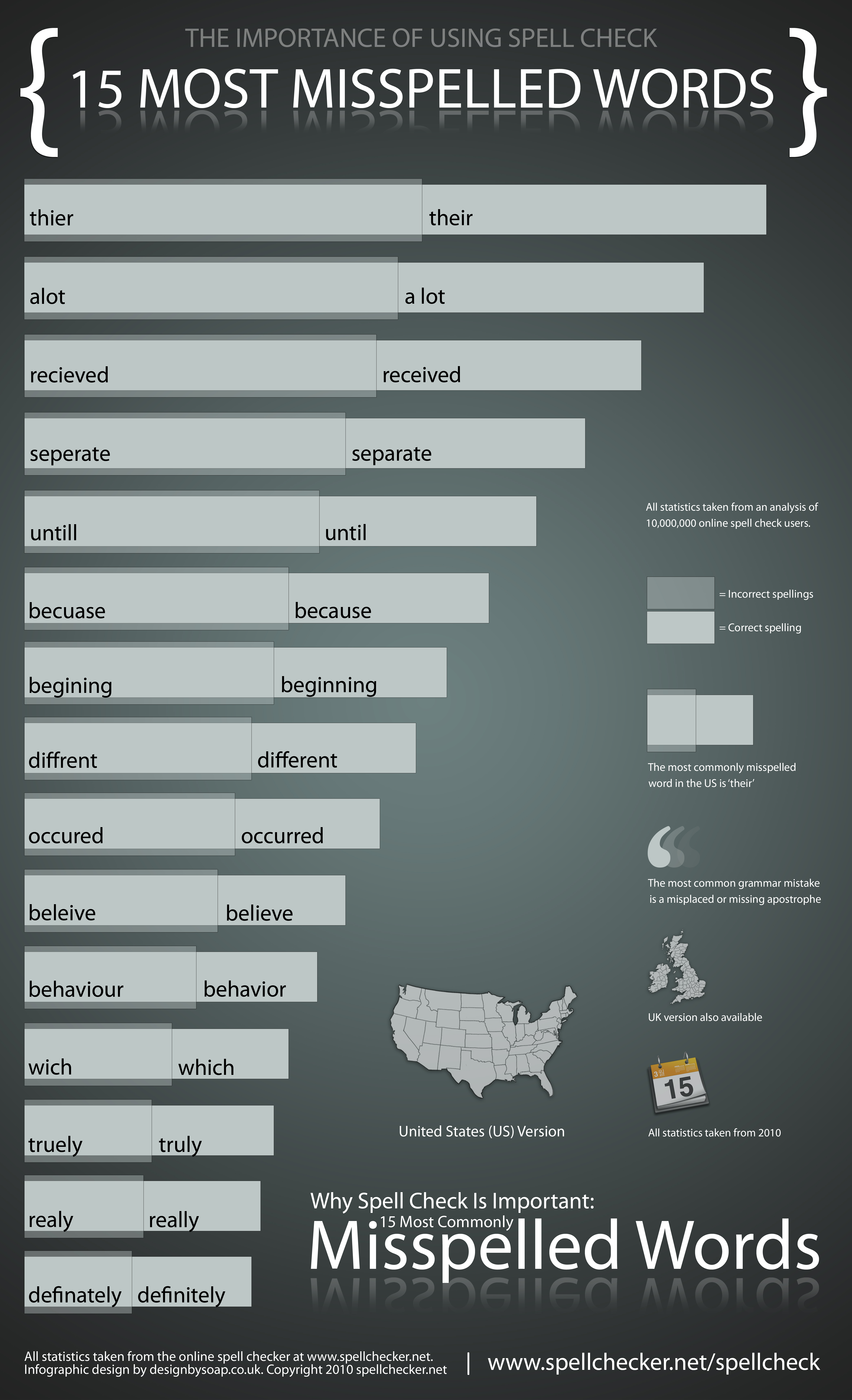
15 Most Misspelled Words

Last night my wife, a fifth-grade teacher at a local elementary school, was telling me about a little memory aid she had developed to help her students learn to spell a lot correctly. "They always spell it as one word," she said.

As I recall, that's when she grrrr-d.

Take heart, my love, your students are not alone in their misspelling of a lot.
Spellchecker.net recently published their list of the 15 Most Misspelled Words in the U.S., and guess which word came in second?

Right, alot.

(Perhaps the whole nation needs that little memory aid.)

Here, then, the full list from Spellchecker.net.

Misspellers, beware.

Tuesday, February 8, 2011

Tidbittles from an Editorial Mind

Odd bits and pieces of editorial wisdom. (Or stupidity, depending on how you look at it.)

  • Don't use colons after a heading. I mean, it's a heading, it's already separated from the body text. Why add a colon? It's redundant.

  • While we're at it, stop using underline in headings too. Also redundant. And annoying.

  • We ought to stop using "upon" when "on" works just as well and doesn't sound quite so pretentious.

  • A reminder: Quotation marks go OUTSIDE the punctuation in nearly all instances. Outside. Outside. Outside.

  • Stop using "and/or." That's just plain lazy. Writers should know the difference between the two. And if you think I'm the only person who fights against and/or, check this out: http://writingmatters.typepad.com/blog/2010/01/using-andor-in-a-sentence-is-just-plain-dumb.html

  • Hopefully, no one will use "hopefully" to mean "I hope." It means "full of hope." If you hope something will happen, say that. Don't say "Hopefully something will happen." Oh, ugh.

Sunday, January 30, 2011

3 Tips for Citing Sources in Non-Academic Writing


According to a recent study from the American Society of Know Everything Writers (ASKEW, for short), footnotes belong to academic and professional journal writing, not popular writing.


Nah, just kiddin'. ASKEW doesn't actually exist, but you knew that already, didn't you.

For college students, citing sources is a big deal. They want to know how each professor wants the citations formatted. Should they use APA style? ASA? MLA? Chicago? Oh, goodness gracious, what should they use?

Trouble is, when these students graduate and start writing in the "real world," they'll hardly ever use footnotes. However, anyone who wants to write for a non-academic publication needs to understand how to make it clear to the reader where a particular statistic or quotation came from.

In a footnote, all the information about a particular source is described in one piece of tightly structured content. To integrate a source into, say, a news article, we need to separate that content piece into essential chunks, omitting nonessential parts.

Here are the three chunks that really need to be included and how to present them.
1. Who/what said it
Arguably the most imp0rtant chunk, the who/what piece of the source gives the reader a critical context for the information presented. You don't need to go into detail straightaway, you can give the main researcher's name first, and then the affiliation later.

Examples:
  • Cardiologist Michael Smith headed a study that...

  • A recent study at Johns Hopkins School of Medicine indicates that...

  • According to the Centers for Disease Control...

2. When it was said

Timing of the study also plays a key role in in-text citations. For most purposes the exact date a study was released isn't terribly important, but the month and certainly the year are.

Readers need to understand how recently a study was done if only to satisfy their curiosity. This is especially true for newspapers, news-related blogs, and other outlets that feed news to the public.

Understand, though, that the reader may need more than a simple date. In health care the importance of the date a study was completed depends on whether it was the most recent study of that topic.

Hawthorne
For example, let's say a study on the effects of hawthorn, an herbal agent, was conducted in 2005 and that the agent hasn't been studied since. Should you provide the year?

For most publications the answer would be yes, list the year, but also provide the reader with some kind of framework to enhance understanding. You might say something like, "According to a 2005 study hawthorn, an infrequently studied herbal agent, seems to act..."

3. Where it was said

In-text citations are all about providing some perspective for the reader. Citing the publication in which a study appears gives the reader a sense of source integrity.

The Journal of the American Medical Association (JAMA), the New England Journal of Medicine (NEJM), and Britain’s Lancet, for instance, are widely considered impeccable sources. Publications from companies that might have a vested interest in a study’s outcome, well, not so much.

If you know something about the integrity of the publication, let the reader in on it too.¹

¹ July 12, 1896 study by ASKEW. All rights reserved.

Thursday, January 27, 2011

Guest Blog: What is an Acquisitions Editor?

This is a terrific post about what an acquisitions editor (sometimes called sponsoring editor), written by a trade non-fiction acquisitions editor, Terry Whalin at Intermedia Publishing Group.

Terry Whalin
What's an acquisitions editor?

Some of it doesn't apply to healthcare textbook publishing, but most absolutely does.

Enjoy!

Friday, January 14, 2011

Pre-Ordering and Other Stupid Expressions Writers Should Ban

Pre-explaining my utter
aversion to the use of pre-pretty much anything, I should explain that I have nothing against those three letters and their accompanying itty, bitty dash. Not at all.

However, I object to their use to signify anything we've done before we actually do what we've already done.

Take "pre-packaged," for instance. If a manufacturer packages a food in, say, a bag, it is at that point packaged. How on earth did that same packaged food become pre-packaged when it hits the store, hmmm? What magic occurred en route to make it so?

Please, people of Earth, please stop using this horrifically stupid expression and others like it! To wit:

  • Pre-meeting

  • Pre-conference

  • Pre-reading

  • Pre-writing (We're writers, we can't come up with anything better than "pre-writing" to describe writing warm-up activities?)

  • Pre-order

  • Pre-book

  • Pre-purchase

  • Pre-recorded

  • Pre-drink

  • Pre-enough!


Other stupid expressions


  • Each and every (Can you have an each but not an every? I think not.)

  • Reread (Is rereread next?)

  • Personal friend (Dontcha just hate those impersonal ones? Those bums!)

  • General public (Now, Colonel Public I can understand.)


  • Regular routine (What, there's an irregular routine? Well, helloooo, FiberCon!)


  • Advance registration (Oh, now this one is just silly. It should be pre-registration!)


Do your part. Banish the stupid!

Wednesday, December 22, 2010

3 Keys to Getting Your Textbook Proposal Read for Real

You have an idea for a textbook or clinical resource. Your book could be the next best thing to squeeze-bottle ketchup. It could make you and the publisher very happy. Wonderful!

But if the editor doesn't read your proposal, your book, your baby, your crowning glory might never see the printed page.

Never fear. Here are three keys to make sure the editor reads and truly considers your proposal.
  1. Find the right editor. Sounds like a no-brainer, but it isn't. A publishing company might have 10, 20, even 30 or more editors signing titles in various disciplines. Figuring out which editor is right for your book might prove confusing.

    To find the right editor, go first to the publisher's website and look for an author's area. (For a list of author areas for the major healthcare textbook publishers, check my blog post at http://andymcphee.wordpress.com/2010/10/26/tips-for-writing-a-solid-book-proposal/.

    Look for a list of editorial contacts, and then identify the editor handling the discipline that most closely resembles the discipline you'll be writing for.

    Alternately, you can find a book similar to yours and published by the same company, and then check the masthead for the editor's name. Look for Publisher, Sponsoring, or Acquisitions in the person's title.

  2. Write a compelling proposal lead. Put your best effort into the lead of the proposal. That's where you'll keep or lose the editor's attention. In that lead, tell the editor:
  • Which markets the book is designed for. Be specific. Rather than "The book will appeal to medical assistant programs," write "The book will appeal to medical assistant programs that offer introductory courses in medical billing and reimbursement."

  • Why your approach to the content is superior. Again, be specific.

  • Why you're the right one to write the book. Toot your horn in specific ways. Rather than "I just love this topic," write "My background as a lab tech and 8 years of teaching clinical medical assisting give me an edge."
  1. Make the proposal error-free. This is must. If the editor finds one spelling error, well, okay. But two? Three? More? Forget it. You need correct spelling, punctuation, capitalization—everything. Show the editor that you're a writer.
When I see a proposal from someone who gets all three keys dead-on, oh, I'm reading that proposal.

Friday, December 3, 2010

Bulleted Lists that Make Sense

Where would healthcare textbooks be without bulleted lists?

Nowhere, that's where.

[caption id="attachment_664" align="alignright" width="150" caption="Wanna see some white space?"][/caption]

Bulleted lists are a mainstay of our industry and for good reason. They provide key information in a quick-look format. They help break up paragraphs of text. And they provide a bit of white space on the page. White space is a publishing term for, literally, the white of the page and how much of it shows around the text and images. The white space around bullets, which tend to end at varying widths, helps keep the reader's eye engaged in the page.

When you're writing a bulleted list make sure the sequence of bullets makes sense. Bullets shouldn't be just thrown onto the page willy-nilly, as you think of them, they should be as carefully constructed as everything else you write.

That said, here are four ways to sequence a bulleted list.

  • Alphabetical. This format makes sense for items that need no specific sequence, such as a list of authors or symptoms. Sometimes an alphabetical list would make it easier for the reader to find a particular item. Alphabetized lists are best used when the bullet points are short. The longer the bullets, the less useful an alpha list.

  • Importance. Anytime the items in a list vary by their clinical importance, the list itself can help make that prioritization clear. For instance, adverse reactions are commonly listed by importance, with the most important being first or last, depending on intent. Example:


  • Frequency of occurrence. Like importance, frequency of occurrence can also prove helpful when building a list. Generally this kind of list should be built from the least common to the most common. Example:


  • Length of bullets. Use this format then you have a list of bullets each of which is no longer than the width of a column and when none of the other methods makes sense. Example:


By the way, I developed the list above using the Importance format. Wheeeee!