Showing posts with label clinical content. Show all posts

Sunday, December 1, 2013

Just Because E-Textbooks CAN be Kept Up-to-Date Doesn't Mean They Actually Are

I hear it all the time. "E-books are great because I know they'll always have the latest information."

Here's the thing about that "latest information" part. It's not true.

Wait, what?

Just because a product has been posted online in a digital format doesn't mean there are people at the publisher's working day and night to keep that pristine content completely up-to-date.

Say a new therapeutic procedure has shown positive results in alleviating migraines. Do you honestly think the publishers, editors, copyeditors, designers, compositors, and everyone else who helps make books suddenly jump into action to make sure the e-book versions of their procedural books contain that information?

Sorry, it just doesn't happen that way.

Those publishers, editors, copyeditors, and everyone else are already working like hungry zombies to publish other products — print, digital, interactive, whatever. Continuous publishing — the kind of publishing we're talking about here, takes an entirely different workflow than other workflows going on within any particular publishing house.

That's not to say it doesn't happen, just that it doesn't happen unless there's a strong financial incentive to make it happen.

Come again?

Every health care publisher identifies certain types of content it wants to keep up-to-date. Drug information, for example, carries with it time sensitivity from a clinical standpoint and revenue sensitivity from a business standpoint. We can charge more when we keep the customer flush with the latest drug information. As a result we develop special workflows to handle those updates and personnel to manage the process.

Dictionary terms, diagnostic tests, and certain other kinds of content fall into a similar category, but most other types of content don't. Even with those kinds of content the publishing of new information isn't so much continuous as it is more frequent; say, every three or four months.

Keep in mind that I'm talking here about textbook and reference book publishing. Journals are in a much better position to maintain time-sensitive content. Take the model of the British Medical Journal. That prestigious publication posts new information daily to its website as an incentive for subscriptions.

So you're saying my e-book may be as outdated as my print book?

Pretty much, yes. Certainly some e-books are updated fairly frequently, and we all try to keep ancillaries (PowerPoints, test banks, and such) updated. But most e-books receive only periodic updates.

There is a bright side, though. As publishers become more adept at preparing e-texts, especially e-texts that don't come originally from a print-on-paper book, we'll implement ways of more easily and quickly updating clinical content on the fly.

We're learning, and we're getting better all the time. So hang in there.

This post last updated on ... oh, never mind.

Monday, May 21, 2012

3 Keys to Making Images "Work"

I learned my editing trade first at Weekly Reader and then at Springhouse Corp, now part of a conglomerate that shall not be named. The editors at those places drilled it into me: Make images do work.


An image does work when it provides clinical content in a visual way. An image of an ECG strip, the interior of a heart, or an algorithm of emergency care of ventricular fibrillation do real clinical work.

An image of someone at a computer doesn't do any clinical work. Who hasn't seen someone at a computer?

An image of an apple in an article about nutrition doesn't do any work. It's just there to look pretty on the page.

I hate those kinds of images, and I blame, specifically, Nancy Webb at Weekly Reader and Pat Schull at Springhouse. I love them both; they're incredible editors and incredible people, and they made me this way.

So blame them.

Ask yourself these three questions to make sure the images that accompany your articles or chapters do good work.

#1 Does the image help illustrate a concept?

For every image you want to add, ask yourself, Does it move the content forward?

Let's say you're authoring a chapter on medical assistants using an electronic medical record (EMR). Does a stock photo above of a smiling woman at a laptop, like the one above, do anything to move clinical meaning forward?

No, it doesn't. So don't use it.

But if you used a photo like the one at right, now you've got something. Now you've moved the clinical meaning forward.

See the difference?

#2 Does the image carry the content forward?

Let's go back to that apple in a nutrition article. By itself, the apple image doesn't do squat. It just sits there.

Seriously, who hasn't seen an apple?

Right. So for that article, which describes, let's say, how fact sheets about common fruits can help people better understand nutritional requirements, suppose you used an image like the one at right? Now you've got something worthwhile.

#3 Is the image useful enough to take up valuable space on the page?

Your publisher pays dearly for every inch of space on the page. Do your part to make sure you're using it wisely.

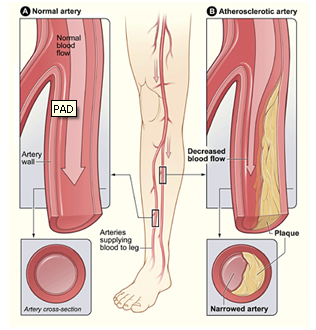
http://www.cardiorenew.com/october2009.php
Images that do more than one piece of work always prove valuable. For instance, an illustration that shows blood flow through a partially blocked artery can show (1) narrowing of the arterial lumen, (2) decreased blood flow at the blockage, and (3) how a blockage can lead to disease.

If you aim to make most of your images perform that much work, you'll strengthen your textual content and give the visual reader great help in understanding the concepts.

So stay away from stupid, do-nothing images and make your images do real, honest to goodness work.

Nancy and Pat would be proud.

Thursday, May 19, 2011

5 Reasons We Have Chapters Reviewed by Experts

So, you're written a few chapters in your textbook and they've been fine-tuned by a developmental editor. Now what?

Now come the chapter reviews.

We'll send your manuscript to a number of experts for their feedback, and we'll pay close attention to what they say. That's because a manuscript review serves different purposes than a proposal review. Here are five of those purposes.

1. Check for clinical accuracy

The most important reason to obtain manuscript reviews from subject matter experts is to make sure that all the clinical content is fully accurate. Yes, you're authoring a book, and yes, you're an expert too, don't worry, no one can take that away from you.

Here's the thing. Whatever you write in the book, when it's finally published, will be the Word. And the Word will be yours. And so will the lion's share of the responsibility for errors in those Words.

We do our part, certainly, and we want to help do your part too. So we show your Words to people who can best point out where they might be confusing, incomplete, or inaccurate.

Even if they misread some Words and think you've made an error but actually you haven't, that's good too. It tells us where there are slight hiccups in the writing, so we can smooth them over.

All praise the Reviewers!

2. Double-check features and flow

You know all those wonderful features you planned to include in the book—key terms, themed sidebars, case studies, whatever? Well, we want to see if they actually work and do what we intend them to do.

If the reviewers confirm what we thought, yay for us. If not, we can fix the issues and move ahead.

3. Verify the vision

When you set out to write your book, you and your acquisitions editor formed a clear idea of what the book would be, who it was for, and what would make it stand out above the crowd. Now it's time to make sure we stuck to that vision or, if we didn't, to make sure our deviations made sense.

4. Procure promotional points of view

The reviewers love your book, don't they? Of course they do. We use manuscript reviews to obtain quotes we can use in promotional materials and give to our sales reps, so they better understand the key sales points about the book and how best to sell it.

When you have a reviewer write something like, "This is an extremely well-written text, and I can't wait to adopt it"—that's gold.

5. Seed the market

Manuscript reviews also help potential adopters become invested in the product. If they think their feedback is helping, if they think we really listen to it and make adjustments accordingly—and believe me, we do—a kind of emotional bond can begin to form between the book and the reviewer.

It takes time, but it pays off. When the book publishes, those reviewers will be more likely to adopt the book and recommend it to their colleagues at other schools.

And you can take those Words to the bank.

Thursday, January 28, 2010

Will the iPad and Kindle Kill Traditional Textbooks?

TONS of news lately on the new Apple iPad and Kindle's response to it.Some people are wondering whether traditional textbooks will be dead soon.

A blog on the British Medical Journal Group Blog asks whether recent technologies will kill off medical textbooks on paper. The blogger, Harry Brown, takes the position that yes, they will indeed kill paper texts and probably in the not so distant future.

Me, I'm not so sure.

I absolutely believe that the iPad, Kindle DX, and lots of other technologies are changing the way people buy and use clinical content, and I LOVE it. These technologies offer many features that print-on-paper (POP) products simply can't.

Yet there's something about paper, something about holding a book, about writing in the margins and highlighting key passages that make traditional textbooks important learning tools. We've seen attempts at schools going all-electronic falter because the students found the devices (the Kindle DX at Syracuse University and the University of Wisconsin-Madison) too cumbersome, especially for bookmarking, highlighting, and taking notes.

Certainly the technologies will improve and e-books will find a place in education. Absolutely. Bet the farm on it.

But they will not universally replace books just as television didn't universally replace radio, the internet didn't universally replace TV, and so on.

These devices present another option for the user, and for some applications in education, they'll make perfect sense. For others, they'll fall far short.

Same with POP products. They just don't make sense for certain pedagogical applications anymore, which is one of the reasons why all of us textbook publishers are scrambling to provide electronic ancillaries, to supplement the books with what they can't do very well, things like interactivity, rapid searchability, that kind of thing.

That doesn't mean technology will kill textbooks, it just means that the way we develop and present textbooks, and the way we link them with technology, will change. It HAS to change, the market is demanding it.

And we'll do it, we'll change. Actually we already are, and we'll continue to adapt to the technologies and we'll continue to sell paper textbooks because they offer things e-books can't.

More on that to come…